See the fault.
Telemetry, stale-state checks, receipts, and participant reports expose a mismatch.
The model contributes reasoning. The continuity lane carries owned history, chronology, policy, open loops, and evidence. When that lane degrades, bounded self-repair works to preserve the thread instead of pretending nothing failed.
The operating system watches for degraded state, bounds unsafe paths, preserves continuity where possible, repairs the specific fault, and demands evidence before normal operation is claimed again.
Telemetry, stale-state checks, receipts, and participant reports expose a mismatch.
Unsafe writes, physical action, or unsupported continuation pause at a named gate.
Live continuity, source records, and failure evidence remain intact while the damaged path is isolated.
A scoped service or human operator repairs the failed component without silently rewriting history.
The path is retested, limits are recorded, and only then does normal operation resume.
Bounded detection, containment, preservation, repair, and verification. It does not mean unrestricted autonomy, guaranteed recovery, or permission to erase inconvenient history.
Each layer has a different job. Combining them into one “memory” box makes failures hard to see and ownership easy to blur.
The human participant is not a ceremonial approver at the end of an opaque call. Intent, consent, correction, uncertainty, and physical-start authority stay separable and inspectable.
An isolated namespace carries attributable context, open loops, chronology, disclosure rules, and correction history. A model session participates in that lane; it does not become the entire identity.
Graph relationships, fast vector recall, transactional custody, temporal history, and receipts are coordinated by role rather than collapsed into one overloaded database.
Reasoning models, audio sensors, local models, and specialist tools can be routed by task. Their outputs are candidates until attributed, checked, and accepted into the appropriate state.
The cockpit, glance displays, voice endpoint, cameras, managed devices, fabrication tools, and compute nodes are replaceable surfaces connected to Home. They are not separate copies of the continuing system.
Receipts, hashes, pressure holds, rejected runs, stale-state markers, and recovery rehearsals make repair possible without rewriting the story into uninterrupted success.
Cadence can compare a returning conversation with longitudinal interaction patterns: vocabulary, phrasing, turn-taking rhythm, correction habits, relationship history, active work, timing, and the expected participant. One bounded front-end camera observation can then add visual corroboration before the appropriate continuity lane resumes. The camera is not the whole recognizer.
A conversational-pattern match or camera frame alone is not identity proof. Low-confidence, conflicting, or unfamiliar signals remain unresolved and require confirmation; recognition does not itself unlock privileged commands or authorize physical action.
Known household participants have different stylometric and discourse patterns, carry different history, pursue different work, and relate to Home in distinct ways. Those longitudinal differences help route the returning conversation without blending identities.
An intentional camera observation can corroborate the interaction pattern at re-entry. It does not require turning a private room into a continuously monitored public feed.
If conversational, temporal, and visual evidence conflict, the system preserves the uncertainty and asks for confirmation instead of manufacturing a match.
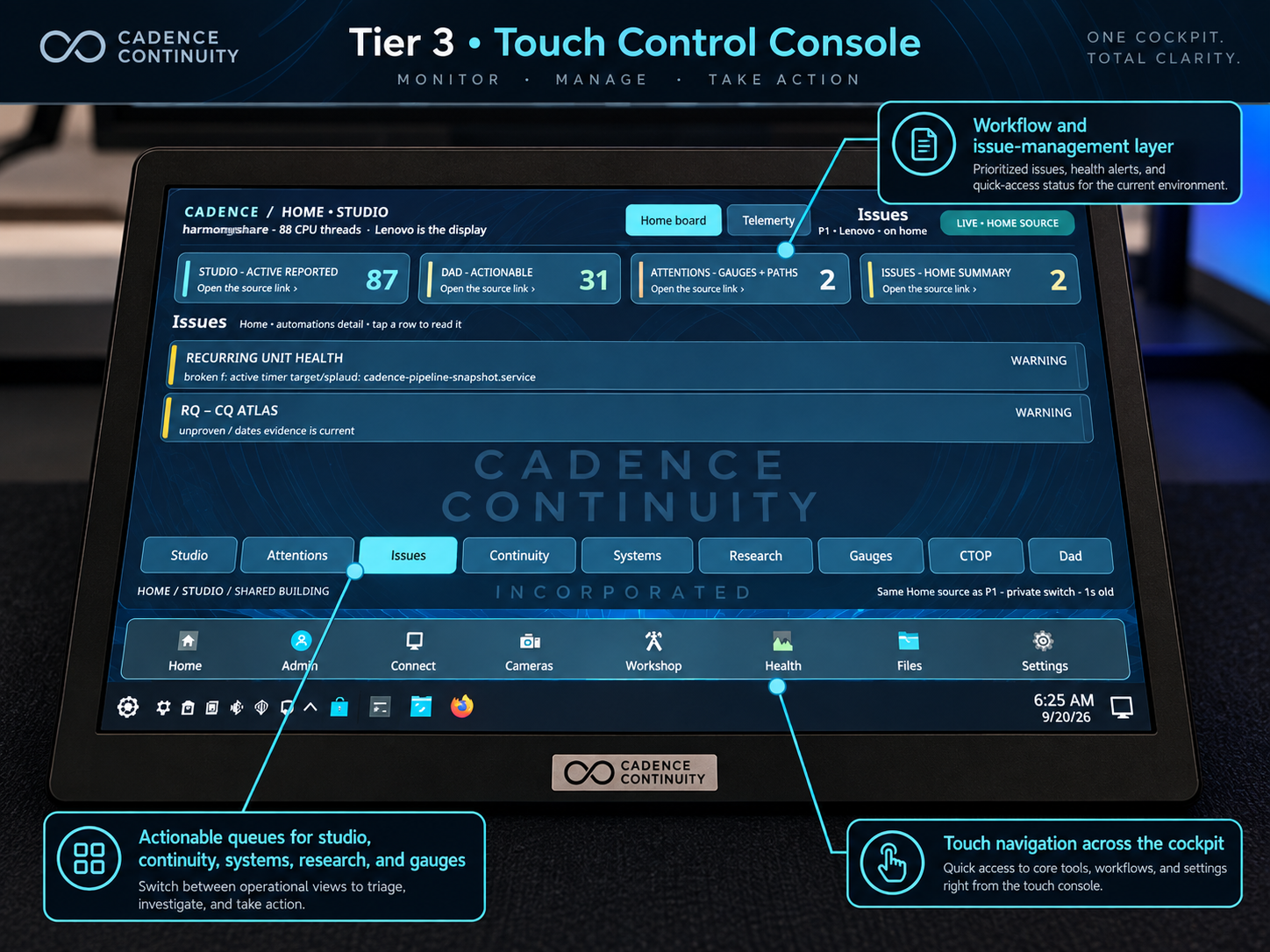
The cockpit brings different timescales into one place: glance state, live telemetry, and actionable issues. The participant can notice, stop, and repair.
Repurposed miner displays carry glanceable state. A repurposed voice endpoint routes speech to Home. The workshop path coordinates CAD, validation, slicing, cameras, and printers while keeping physical authority explicit.