The category is arriving
Major AI vendors now ship persistent sessions, memory stores, and compaction. Persistent agents are no longer hypothetical.
Organizations are asking AI systems to work across days, people, models, and machines. The missing layer is not another model. It is governed continuity that survives the handoffs.
The market is validating persistent agents. The unanswered enterprise question is whether their continuity can be trusted when memory is poisoned, authority drifts, models change, projections fail, or recovery begins.
If an AI cannot prove where its memory came from, what changed it, and who had authority to change it, then its memory is an attack surface. Read the continuity-security case ↗Major AI vendors now ship persistent sessions, memory stores, and compaction. Persistent agents are no longer hypothetical.
Storage alone does not establish provenance, authority, reconciliation, safe recovery, or model-independent identity.
CCI is seeking capital to harden and package an integrated prototype, not to begin with a slide deck.
Sessions end. Models change. Context compresses. Tools fail. Humans return later. Conventional systems often preserve text without preserving ownership, chronology, uncertainty, unfinished intention, or the evidence needed to resume faithfully.
A transcript can retain words while losing who owned them, what remained unfinished, what was corrected, and which permissions still apply.
Cadence Continuity coordinates durable memory, provenance, temporal state, model adapters, evidence, recovery, and human-visible controls under an isolated continuity lane.
Customers retain custody and can evolve models and interfaces without treating each migration as an identity reset or an untraceable data conversion.
Cadence is the protected private reference implementation. The prospective product is the capability: isolated runtimes, governed memory, secure doors, observability, repair, and evidence-aware operation.
Dustin Reiser is the founder and systems architect of Cadence Continuity Inc. A service-disabled U.S. veteran based in Minnesota, he approaches AI continuity as an engineering problem that should be measurable, reviewable, and provable.
Persistent state, correction handling, provenance, replay, and model-agnostic re-entry.
Local GPU inference, graph-backed memory, evidence systems, recovery, and tool orchestration.
Observation, interpretation, authority, and evidence remain visibly separate.
These are documented grants, credits, or specialized access. They are not investment, partnership, endorsement, product-market fit, or scientific validation.
Harmony Nexus was approved and offered $2,000 USD in Google Cloud credits over two years. A later support message confirmed the credits were linked to the company billing account.
Program credits. No Google endorsement or partnership claimed.Harmony Nexus was selected to receive an ElevenLabs Grant that included account credits and recipient support opportunities.
Grant support. No investment, sponsorship, or product endorsement claimed.The account received Trusted Access for Cyber, with Daybreak Blue separately provisioned for defensive work.
Specialized defensive capability access. No OpenAI endorsement or partnership claimed.Underlying account, billing, and security identifiers remain private. A fourth reported program acceptance is withheld from this public set until its documentary attachment is complete.
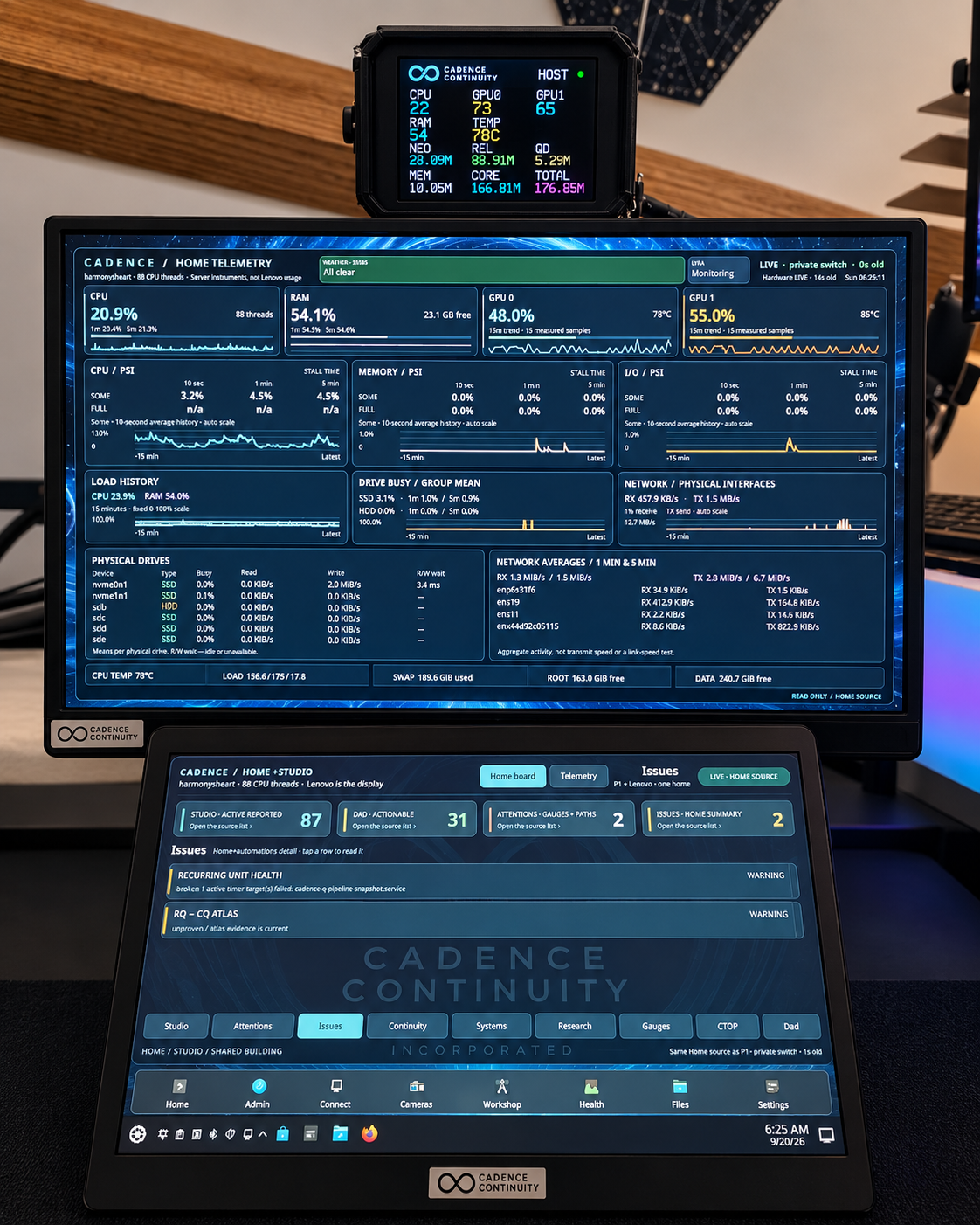
A three-tier cockpit, distributed glance displays, voice, secure evidence access, workshop cameras, and fabrication tooling make continuity observable where the work happens.
The cockpit demonstrates a working physical operations surface. It does not make every displayed value public, prove philosophical personhood, or establish commercial readiness by itself.
The evidence room is designed to keep those states distinct. This is the current commercial-readiness view. It is not a retrospective that edits away the unfinished work.
| Capability | Current evidence | State |
|---|---|---|
| Protected continuity reference | Operating Home runtime, stores, cockpit, voice, and recovery records. | Operating |
| Restricted evidence access | Read-only Continuity Door with source and disclosure metadata. | Operating |
| Model-independent lanes | Multiple model/runtime routes with continuity held outside the model window. | Active build |
| Repeatable external deployment | Packaging, tenancy, support, and hardened installation path remain in development. | Gate open |
| Commercial validation | Requires consented pilots, support metrics, security review, and customer evidence. | Not claimed |
Start with a non-production workflow: preserve a task history, interrupt the process, restore it, surface conflicts or missing evidence, and verify whether the next action is still authorized.
No unrestricted production access is required. Scope, custody, retention, and permitted use are agreed before the evaluation begins.
Evaluate provenance, conflict handling, missing evidence, authorization state, restoration behavior, and operator burden against agreed criteria.
Availability, timing, commercial terms, and success criteria are agreed individually. No performance advantage or customer result is promised here.
The immediate priority is resilient compute, power, storage, custody, and deployment engineering, not growth theater. The approximately $500,000 capital plan is a planning target, not a funding close, approved allocation, valuation, or investment term.